
Project Overview (NDA-Friendly)
BV Conecta is a Customized Enterprise SaaS used by Customer Support operators at Banco BV, one of Brazil's largest private financial institutions, to access critical information, procedures, and guidance during client interactions.
As the operation scaled, daily use of the tool began to reveal navigation issues, outdated content, and complex flows, which directly affected handling time, operator confidence, and, ultimately, the customer experience.
I was hired via Datum as a UX/UI consultant for this project to diagnose the main obstacles, conduct a structured discovery process, and propose improvements to make BV Conecta clearer, more efficient, and more accessible for the people who rely on it every day.
My Role
The sole UX/UI Designer on the team, responsible for the entire Research, Discovery, and Strategy process in collaboration with Customer Success (CS), Operations, Product, Compliance, and Development teams.
My responsibilities included:
Leading the entire Discovery process
Conducting quantitative and qualitative research
Mapping operator flows and journeys
Performing usability and content analysis
Conducting benchmarks of market platforms
Proposing structural improvements in navigation, content, and workflow
Documenting findings, opportunities, and the implementation roadmap
The Challenge
During the diagnostic phase, several real problems emerged — issues operators faced on a daily basis:
Complex navigation with too many clicks to find information
Duplicated, outdated, or contradictory content
Lack of clarity for new operators
High cognitive load during customer interactions
Limited visibility into back-office processes
Slow content curation, with responses taking 3 to 5 business days
Performance pressure, leaving little time for training
To deeply understand how operators actually used BV Conecta and identify opportunities to make the platform faster, more intuitive, and more reliable, I conducted quantitative research with over 100 operators and field observation (shadowing) with operators providing customer service in real time.
Key Findings:
1. Navigation required too many steps, slowing down service
- Operators needed multiple clicks to find any procedure. - Lack of hierarchy and inconsistency across information. - Contradictory or outdated content. - Different versions of the same process spread across multiple pages. - Operators felt insecure and often searched for answers outside the platform.
2. The tool did not support the operation at scale
3. Limited support for learning and operator autonomy
Business Impact
BV Conecta is essential for daily customer support operations, but the way information was organized—complex navigation, redundant content, and lack of hierarchy—made decision-making harder for operators. This not only slowed down their work but also compromised the accuracy of responses and the overall quality of service.
The platform’s structural issues directly affected operational metrics and customer satisfaction.
Difficulty locating essential information
The lack of organization and hierarchy made searching for procedures slow and unintuitive, forcing operators to navigate through extensive menus. This increased cognitive load, delayed service, and reduced operational efficiency.
Increase in rework and inconsistent responses
Duplicated, outdated, or scattered information created insecurity among operators. To ensure accuracy, they relied on parallel systems, colleagues, or external searches—generating rework and increasing the risk of incorrect guidance.
Growing volume of repeat calls and complaints
Unclear processes and difficulty verifying information contributed to human error and incomplete responses. This led to repeat calls, customer dissatisfaction, and operational strain, directly impacting service quality.
Decline in operational KPIs (such as AHT and adherence)
Multi-click navigation and long flows raised AHT (Average Handling Time) and affected key efficiency indicators. Operators spent more time on simple tasks and less on solving real customer problems, harming overall performance.
Action Roadmap
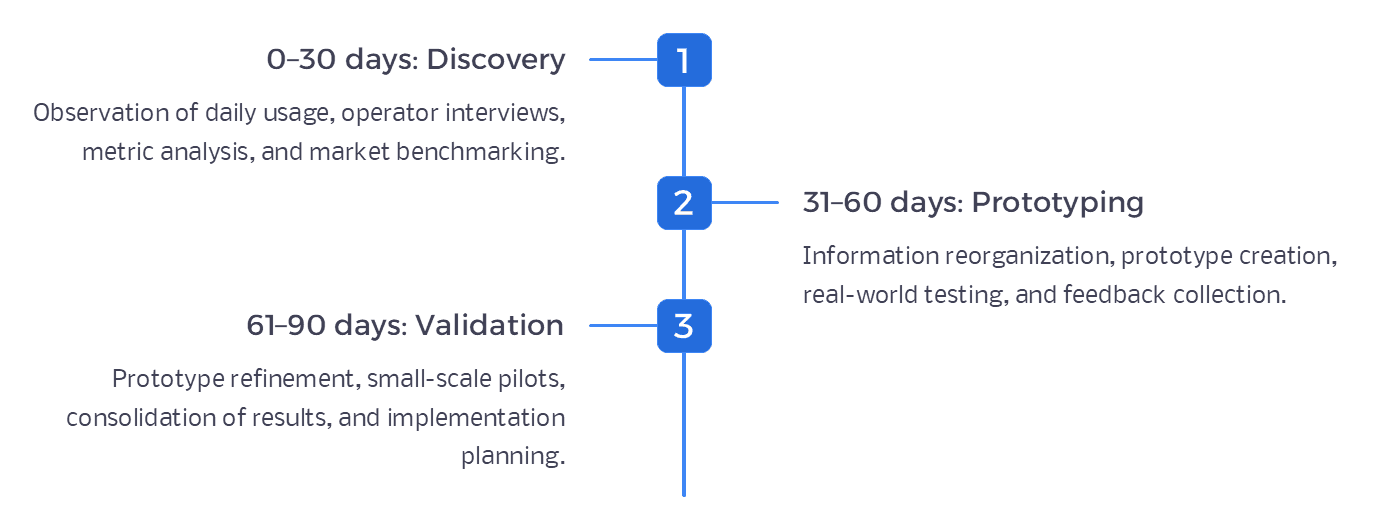
I developed a clear and realistic roadmap divided into three phases—Discovery, Prototyping, and Validation. This roadmap helped the team visualize the platform’s evolution and understand which deliverables should be prioritized in the short term.
Key Results and Deliverables
Throughout the project, I carried out an in-depth analysis of operators’ experience with BV Conecta, identifying real improvement opportunities and structuring clear deliverables to support business decisions. The focus was on generating practical value for operations: more autonomy, less friction, and a more efficient experience for the people who use the tool every day.
Complete diagnostic of the current experience (As-Is)
I mapped the main operator flows and journeys, identifying barriers such as excessive clicks, inconsistent content, lack of hierarchy, and navigation difficulties. This diagnostic consolidated a clear and actionable view of the critical pain points affecting KPIs like AHT, FCR, and customer satisfaction.
Detailed usability and content analysis
I conducted an in-depth review of the platform’s structure, categorizing types of issues (navigation, content, operational performance, curation, learning). This material enabled the team to clearly see where the highest-impact opportunities were, supporting prioritization and decision-making.
Research-validated insights (quantitative and qualitative)
Research with operators provided concrete evidence of the challenges faced in their daily routine. These insights were translated into improvement themes that informed all strategic recommendations, bringing legitimacy and confidence to future decisions
Structural improvement proposals
Based on the analysis and roadmap, I delivered guidelines for reorganizing the information architecture, simplifying flows, updating content, standardizing formats, and supporting operator learning. These proposals were designed to work within compliance constraints and existing legacy systems.
Key Learnings
This project strengthened my experience in:
Leading high-complexity discovery processes
Designing under strict compliance constraints
Balancing business needs with operational workflows
Facilitating decision-making across multiple teams
Turning complex problems into clear, feasible solutions
It was an intense and enriching experience, especially due to the close collaboration with customer support teams and the direct impact on the daily routine of those who interact with end customers.